How to Promote SEO Content in 2025: 10 Steps That Actually Drive Traffic

You spent 4 hours writing a great article. You hit publish. Then nothing happens. No traffic. No shares. No rankings. The article sits there collecting dust while you wonder what went wrong.
Here is what went wrong: you skipped promotion. Writing is 40% of the job. Promotion is the other 60%. These are the 10 steps I take for every piece of content I publish to make sure it actually gets seen.
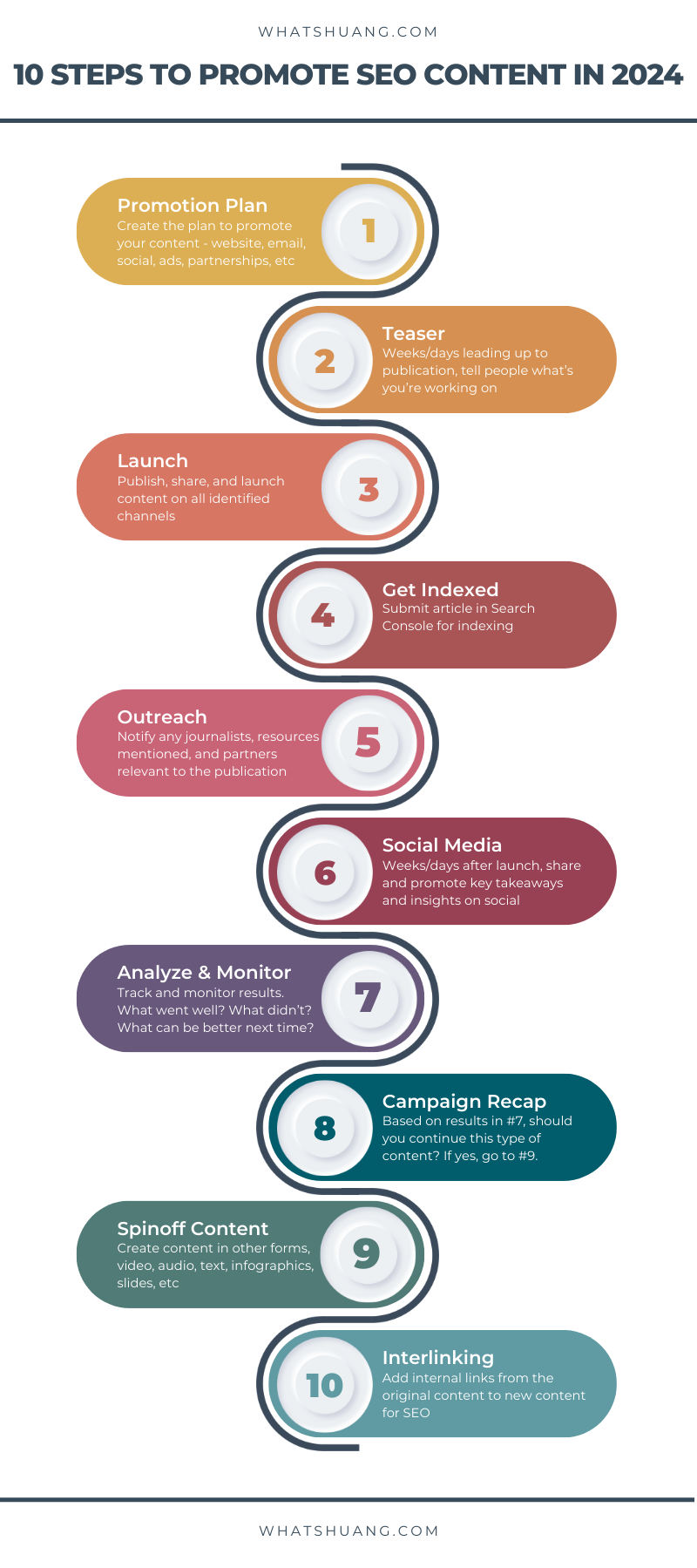
1. Build a Promotion Plan Before You Publish
Do not publish first and figure out promotion later. Your promotion plan should be ready before the article goes live. Here is the framework I use:
Where and How to Promote
- Website -- Popup, notification banner, menu navigation, homepage callout, sidebar widget
- Social media -- Teaser content, launch posts, and post-launch clips on Facebook, Instagram, LinkedIn, X, TikTok, and Threads
- Email -- Newsletter campaign to your list, segmented by topic interest
- Partnerships -- Outreach to people and brands mentioned in the content, influencer network, guest post swaps
- Ads -- Google, Meta, LinkedIn, ad networks, sponsorships
- AI-assisted distribution (new for 2025) -- Repurpose the article into 5+ formats using AI: tweet thread, LinkedIn carousel script, short-form video script, email newsletter, and podcast talking points. One article becomes a full week of content across every channel.
When to Promote
- Website -- The moment the post goes live
- Social media -- 2-3 teaser posts before launch, 1 launch post, 3-5 posts in the 2 weeks after launch
- Email -- Send within 24 hours of publishing
- Partnerships -- Outreach the same day the post goes live (strike while it is fresh)
- Ads -- Only after you see organic engagement signals. Do not boost content that nobody engages with organically.
Pro tip: I use a simple spreadsheet to track every promotion action. Columns: channel, content piece, date scheduled, date published, link, performance notes. Simple. Repeatable. Nothing falls through the cracks.
2. Tease the Content Before Launch
Teasers are underrated. They prime your audience and build anticipation. More importantly, they give you feedback before you publish.
How I tease content in 2025:
- Poll your audience. Post a question related to the article topic on X or LinkedIn. "What is the hardest part about [topic]?" The responses tell you what angle resonates.
- Share a hot take. Pull the most controversial or surprising data point from the article. Post it without context. Let people argue in the comments. Then drop the full article link.
- Behind-the-scenes clips. Screenshot your research process, your outline, or an interesting data point you found. "Working on something about [topic]. This stat blew my mind."
- Countdown on Stories. Instagram and Facebook Stories with a "drops tomorrow" teaser. Works especially well if you have an engaged following.
The goal is not just awareness. It is to test which angle gets the most engagement, then lead with that angle in your launch post.
3. Coordinate a Launch (Not Just a Publish)
Hitting the publish button is not a launch. A launch is a coordinated push across every channel within a tight window. You want maximum impact in the first 48 hours because early engagement signals tell algorithms (and Google) that the content matters.
My launch checklist:
- Publish the article
- Submit to Google Search Console (Step 4)
- Send the email newsletter
- Post on all social channels within 2 hours
- Share in relevant Slack communities, Discord servers, and Facebook groups
- Text or DM 5-10 people who would genuinely find the article useful (not spam -- genuine value)
- Post in any industry forums or subreddits where the content is relevant
Timing matters. I publish between 8-10am ET on Tuesday through Thursday. These are consistently the best performing days and times for B2B and marketing content based on my own data. Test your own schedule and find what works for your audience.
4. Get Indexed Immediately
Do not wait for Google to discover your content. Be proactive.
My indexing process:
- Google Search Console -- Submit the URL for indexing via the URL Inspection tool. Do this the same hour you publish.
- Bing Webmaster Tools -- Same thing. Submit the URL. Bing is growing as a traffic source thanks to AI search integrations.
- IndexNow -- If your CMS supports it, enable IndexNow for instant notification to Bing and Yandex when new content goes live.
- Internal links -- Add links to the new article from 3-5 existing high-traffic pages on your site. This tells Google's crawler to find the new page faster.
- XML sitemap -- Verify the new URL appears in your sitemap. Most CMS platforms handle this automatically, but check anyway.
Why this matters more in 2025: With AI Overviews pulling from indexed content, the faster your content gets indexed, the sooner it can appear in AI-generated answers. Speed to index is speed to visibility.
5. Strategic Outreach to People Featured in Your Content
How-to articles and listicles get the most engagement. When you create this type of content, you will naturally mention tools, brands, and people. That is your outreach list.
My outreach framework:
- Make a list of every brand, tool, or person mentioned in the article.
- Find their contact. Twitter/X DM, LinkedIn message, email, or website contact form.
- Send a personalized note. "Hey [name], I featured [your tool/brand] in my latest article about [topic]. Thought you might find it interesting. Here is the link."
- Do not ask for anything. Seriously. Do not ask them to share it, link to it, or promote it. Just let them know. The good ones will share it on their own because it makes them look good.
Success rate: About 20-30% of people I outreach to will share the article or give a backlink. That is significant free distribution.
New for 2025: I also outreach to newsletter curators. There are hundreds of niche newsletters that aggregate the best content on a topic weekly. One inclusion in a popular newsletter can drive 500-2,000 targeted visitors in a single day.
6. Slice and Dice for Social Media
Create once, promote 10+ times. One article contains multiple insights, data points, and takeaways. Each one is a standalone social post.
My repurposing framework:
- Pull 5-8 key takeaways from the article. Each becomes its own post.
- Create a carousel (LinkedIn and Instagram) summarizing the main points with visuals.
- Record a 60-second video reacting to the most interesting finding. Post on TikTok, Reels, and Shorts.
- Write a tweet thread walking through the key points. End with a link to the full article.
- Post a "hot take" version that is intentionally provocative. Engagement drives distribution.
AI-assisted repurposing in 2025: I feed the full article into Claude or GPT-4o with a prompt like: "Turn this article into 8 social media posts. 3 for LinkedIn (professional tone), 3 for X (punchy, opinionated), and 2 for Instagram (visual-first with hook lines). Each post should highlight a different insight from the article."
This takes 5 minutes and gives me 2 weeks of social content from one article. For prompt inspiration, check out best practices for ChatGPT prompts.
Spacing matters. Do not dump all your posts in one day. Spread them out over 2-3 weeks. Different audiences are active on different days. Give every post a chance to breathe.
7. Analyze and Monitor Performance
You cannot improve what you do not measure. Here are the metrics that actually matter, organized by what they tell you:
Traffic metrics (is anyone seeing this?):
- Page views and unique visitors
- Traffic sources (organic, social, email, referral, direct)
- Organic search impressions and clicks (Google Search Console)
Engagement metrics (do they care?):
- Time on page (aim for 3+ minutes on long-form content)
- Scroll depth (are people reading past the intro?)
- Bounce rate (are they leaving immediately?)
- Heatmaps (where are people clicking and pausing?)
SEO metrics (is it ranking?):
- Target keyword ranking position
- Total keywords ranking (including long-tail variations)
- Featured snippet captures
- AI Overview citations (new metric -- use GEO tools to track this)
Conversion metrics (is it driving business?):
- Click-through rate on internal CTAs
- Leads generated
- Email signups
- Revenue attributed (if applicable)
When to check: Day 1, Day 7, Day 30, Day 90. Do not obsess over daily fluctuations. SEO content needs 30-90 days to find its ranking position.
8. Campaign Recap and Decision Making
After 30 days, do a formal recap. Answer three questions:
- Did it meet expectations? Compare actual performance against your goals. If you expected 500 visits and got 2,000, figure out why. If you expected 500 and got 50, figure out why.
- Should I double down? If the content performed well, invest more. Update it with new information. Create follow-up content. Build a content cluster around the topic.
- Should I cut my losses? If it flopped despite good promotion, the topic or angle might be wrong. Do not throw more resources at content that the market does not want.
The decision framework: Content that drives traffic AND conversions gets expanded into a series. Content that drives traffic but no conversions gets optimized for CTAs. Content that drives neither gets reviewed for SEO issues or retired.
9. Create Spinoff Content Across Formats
One great article should become 5+ pieces of content across different formats. This is not optional in 2025 -- it is how you compete.
Spinoff formats:
- Video -- Record a YouTube video covering the same topic. YouTube results appear in Google SERPs. One topic, two ranking opportunities. Here is how I use AI for video creation.
- Audio -- Turn the article into a podcast episode or audio summary. Tools like NotebookLM can generate podcast-style discussions from your article automatically.
- Visual -- Create infographics, data visualizations, or AI-generated images for Pinterest and Instagram.
- Short-form video -- Pull one key insight and create a 30-60 second TikTok or Reel. These drive awareness that feeds back into search demand.
- Newsletter deep-dive -- Write an email-exclusive version with additional insights not in the article. Reward your subscribers with exclusive content.
- Slide deck -- Turn key points into a SlideShare or LinkedIn document post. These get surprisingly good engagement.
AI makes this 10x faster. Feed the article into AI and ask for each format. What used to take a content team a week now takes one person an afternoon.
10. Build the Internal Link Web
Every new article should strengthen your entire site, not just exist in isolation. Internal linking is the most underutilized SEO tactic I see.
My internal linking process:
- Link FROM the new article to 3-5 existing relevant pages. Do this during the writing process, not after.
- Link TO the new article from 3-5 existing high-authority pages on your site. This passes link equity and helps the new article rank faster.
- Update your pillar content. If you have a comprehensive guide on the topic, add a link to the new article as supporting content.
- Use descriptive anchor text. Not "click here." Use the actual keyword or a natural description of what the linked page covers.
- Audit quarterly. Every 3 months, review your top 20 pages and add new internal links to recent content. Tools like Link Whisper or Screaming Frog can help identify opportunities.
Why this matters: Internal links are one of the few ranking signals you have complete control over. A strong internal link structure helps Google understand your site hierarchy and passes authority from your strongest pages to your newest content.
In Conclusion
Writing great content is only half the battle. The promotion process -- planned launches, immediate indexing, strategic outreach, social repurposing, performance tracking, and internal linking -- is what separates content that ranks from content that disappears.
Build the system once. Run it for every article. The compound effect of consistent promotion across channels is how you turn a blog into a traffic engine.
Related articles: How I Use AI SEO to Get on Page 1 · Using AI for SEO Content Creation · SEO Tactics That Work
Author
Want more like this?
I write about AI implementation, automation, and growth marketing. No hype.